This first Halo is tuned: Minor Pentatonic 9 - C ding - F Ab Bb C Eb F G
For more info: http://halo.pantheonsteel.com/
This first Halo is tuned: Minor Pentatonic 9 - C ding - F Ab Bb C Eb F G
For more info: http://halo.pantheonsteel.com/
For more information: http://halo.pantheonsteel.com/

You'll find all of the details here: http://www.ztamplifiers.com/products/
I don't own one (yet), but this little guy is now at the top of my wish list.
Anyone want to buy a 30 watt Crate Taxi amp, cheap?

"The Hang Drum is a unique tone based percussion instrument,
which is almost impossible to come by, since there is only one maker in the
world and less than 1000 drums in circulation. The instrument has a soft,
sorrowful, melancholic tone to it and is a perfect companion for emotional or
ambient type of scores. The Tonehammer Hangdrum is unique in the sense it was
recorded at an average of 15 velocity layers and with 10 round-robin repetitions
pr. layer/note, so you will never experience any repetition in the articulation.
We used custom microphone set-ups to capture the delicate resonance both inside
and outside the drum, since the resonance defines the true sound of the drum.
Additionally we sampled multiple playing techniques with fingers, palm, slaps,
hand brushing and the back-side of the drum, which has the similar properties to
the Udu. Multiple versions of all multis allow for a variety of ways to switch
or fade between articulations while playing.


I want to play this drum with my hands, like a frame drum. So the question is which of these head material choices will provide the best sound, with the most overtones? I plan to tighten it pretty tight. I am thinking that timpani head would be good, but they don't make 'em this large.

I come before you humbled in this posting. I thought that I had a great idea to advance the design of the Hank Drum by accomplishing two goals:
1. Speed the cutting time for new drums.
2. Reduce the pain in @$$ cutting of the small curves in the tongues, and save blades lost when they break cutting the small curves.
So I sat down with Visio and designed a new tongue design which (on paper) seemed like a great idea. I borrowed the concept from woooden tongue drums which I have played in the past. In the picture to the left you can see the basic design, a large hole cut from the center and then the tongue cut back from there...
Wel l, the result was not what I expected at all...
From the picture on the right, you see the completed drum. BUT it doesn't sound great at all. After the initial removal of the hole in the center (5" in diameter) the drum sounded like a Tibetan Bowl!
Even after I cut the first tongue (the lowest D note) the drum sounded great. The low D note rang for a long time. But as soon as I cut the second tongue, the whole drum design went south... the addition of a second tongue confounded the first note and neither note sounds good. To complete the experiment I finished cutting the whole thing out. I did achieve one goal - the total cutting time was less than an hour!
My advice: don't waste $30 in this design direction. But I am going to salvage the tank by cutting out the tongues and getting back to that awesome sounding large Tibetan Bowl!
Check out the Hank Drum Collective: http://hankdrum.collectivex.com
This is the coolest external portable speaker device that I've seen. Runs with any type of MP3 player. Runs on batteries or USB power from your computer.
Looks like it's backordered until the end of June.

 I used the same rig to remove the metal bracket on the bottom of the tank. This part of the tank becomes the playing area.

 WHAT: Hang Concert featuring Alan Tower, Gary Muszynski, Matt Venuti, Kim Riccelli, Daniel Tucker, Jessica Styler and other special guests.
 Here's an illustration of Dennis's original configuration (in D Minor Pentatonic)


Link to Dennis's plans: http://www.ehhs.cmich.edu/~dhavlena/for-webpage-lp-hang.htm
 Check out this new drum produced by the Dideridoo Store. They've named it a HAPI (Hand Activated Percussion Instrument).
 Or here: http://www.hapitones.com/
Here's a video: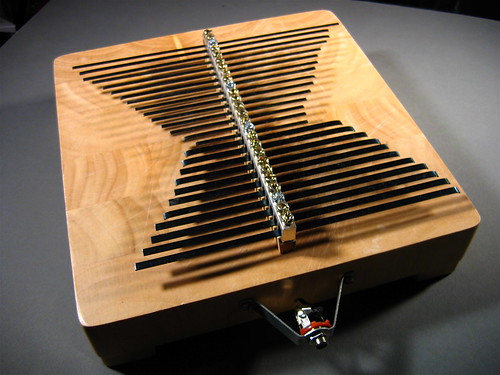 Here's an excellent example of a simple to make lamellaphone. The primary element here is an electrician's grounding bar. Combine that with some tempered spring steel, in two widths: 1/8" and 3/16" & you got yourself a lamellaphone (otherwise known as a Kalimba).
 I had the opportunity to take my completed Hank Drum to the Northern California Flute Circle's Spring Flute Festival, which was held on April 26 -27, 2008 in Georgetown, CA. I left the Hank Drum at one of the flutemakers booths while I was working another booth. I came back later in the afternoon to hear tales of lot's of folks stopping by the play the drum!
 , he hadn't finished painting the drum, but since it was his first drum, he thought that a simple spray paint job with some spray paint would do just nicely. As you can see from the pictures, his drum came out fantastic. I'm painting mine this weekend with a basic spray paint job. Notice also that Russ took off the metal hooks on the blank rubber cords and fastened the ends together with a line of cord (actually, you can't see this in the pictures). Finally, I was impressed by Russ's ingenuity with the creation of a base from a piece of pipe, a pipe fitting, a piece of wood and and some rubber feet. (see photo on right)


 Here's a great how-to article about how to create a cardboard ukulele.


This is Peter's unique design. You gotta listen to the sound sample to appreciate what this instrument can do.
To really understand and appreciate the design enhancements which Peter has made here, you need to visit the design page on the website:
 OK, admittedly, this has nothing to do with music, but I am space fan and the Google Lunar Xprise is just too cool of an idea not to spread the word around. They announced the first 10 participants in the race this week. Now you can purchase this t-shirt to show your support for the event.


Additional thoughts:
First of all, props to Dennis Havlena for his incredible ideas! Keep 'em coming...
Second, I took a dowel, inserted it though the value hole, placed the end on the backside of a tongue and then hit it several times with a hammer. This pushed the individual tongue "up" above the surface of the tank bottom. I think that this make it more playable.
Third, I've also been playing around with the strategic placement of modeling clay on the tank bottom to help eliminate some of the overtones, attempting to get a purer sound.
Fourth: Check the "How To" link section on the sidebar of the blog for additional blog entries on Hank Drum construction.
I'll post a YouTube video once I get a moment to record something.
Join the Hank Drum Collective: http://hankdrum.collectivex.com
